GNSS
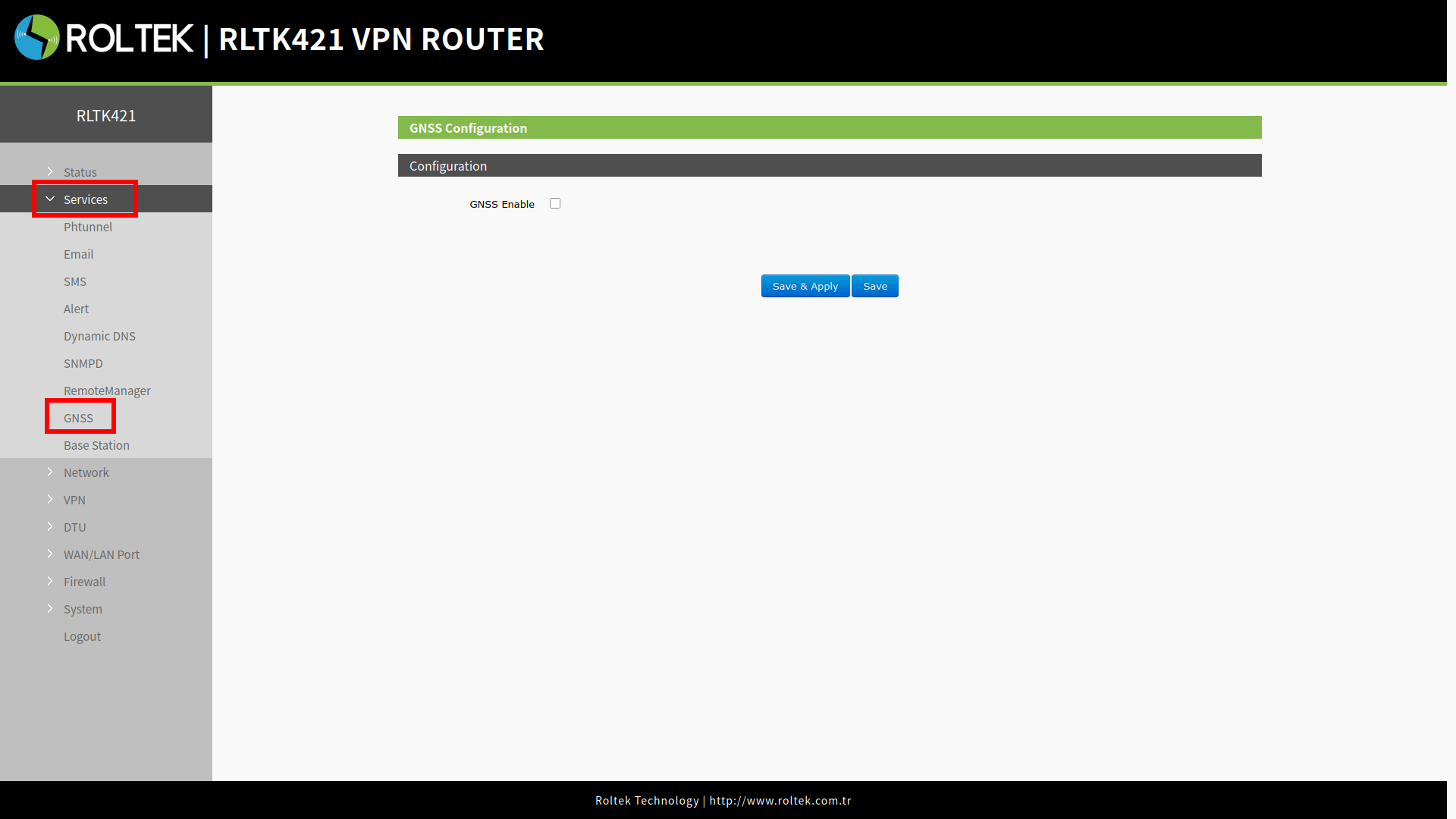
For the device's GNSS settings:
- Services
- GNSS
follow the menus. After enabling the GNSS service with the GNSS Enable button, GPS data can be transmitted to the user's TCP server in GPGGA or GPRMC format with the necessary adjustments.
| Parameter | Description | Default Value |
|---|---|---|
| Enable | ON/OFF | OFF |
| Position Type | GNSS CUSTOM: To transmit data to custom servers | GNSS CUSTOM |
| Network Operating Mode | INDE: Transmit position data via independent socket, MULT: Transmit position data via DTU socket | INDE |
| Operating Mode | When Network Operating Mode is INDE, Operating Mode must be set: TCPC: Connect as a TCP client to the server, TCPS: Wait for client connections as a TCP server, supports up to 8 client connections | TCPC |
| Server Address | The IP address or domain name of the server to which the client will connect | |
| Server Port | The port number listened to by the server | 2317 |
| Reg Enable | ON/OFF | OFF |
| Reg Type | IMEI/SN/ICCID/IMSI/User-defined User-defined: The user can customize the content of the registration package as needed. | User-defined |
| Reg Packet | A-F, a-f, 0-9, hex data, even bit | 7777772E7573722E636E |
| Heart Pkt | ON/OFF | OFF |
| User-Defined Heart Packet | A-F, a-f, 0-9, hex data, even bit | 123456 |
| Heartbeat Interval | Unit: seconds, Range: 1~600 | 30 |
| GNSS Heart Type | NMEA GPGGA: GPGGA format, NMEA GPRMC: GPRMC format |
Note: If the SIM card is not inserted and GNSS configuration is required to capture the device's GNSS information, ensure that the "LTE module prohibits reset" option in Network -> APN Settings is checked.
- The network channel can choose to multiplex the DTU channel. If you want to send GPS data to multiple servers simultaneously, you can choose to multiplex the DTU channel and enable multiple sockets for transmitting GPS data.
- Note: GNSS is only effective in transparent mode when using DTU multiplexing.
- When GNSS multiplexes the DTU and operates in TCPS mode, it can connect to a maximum of 8 clients.
- When DTU socket multiplexing is used: Reporting time (reports are sent on time, independent of DTU data transmission/reception).
- When DTU socket multiplexing is used: Location packets can be sent to the serial port or network endpoint.
- When DTU socket multiplexing is used: When normal heartbeat packets and location heartbeat packets are present together, location heartbeat packets take higher priority.